![고기 잘 굽는 프로 직업인 양성한다고? [이환주의 생생유통]](https://stage.nanrofoundation.com/api/media/file/press-7d7ac88ed699-1.jpg)
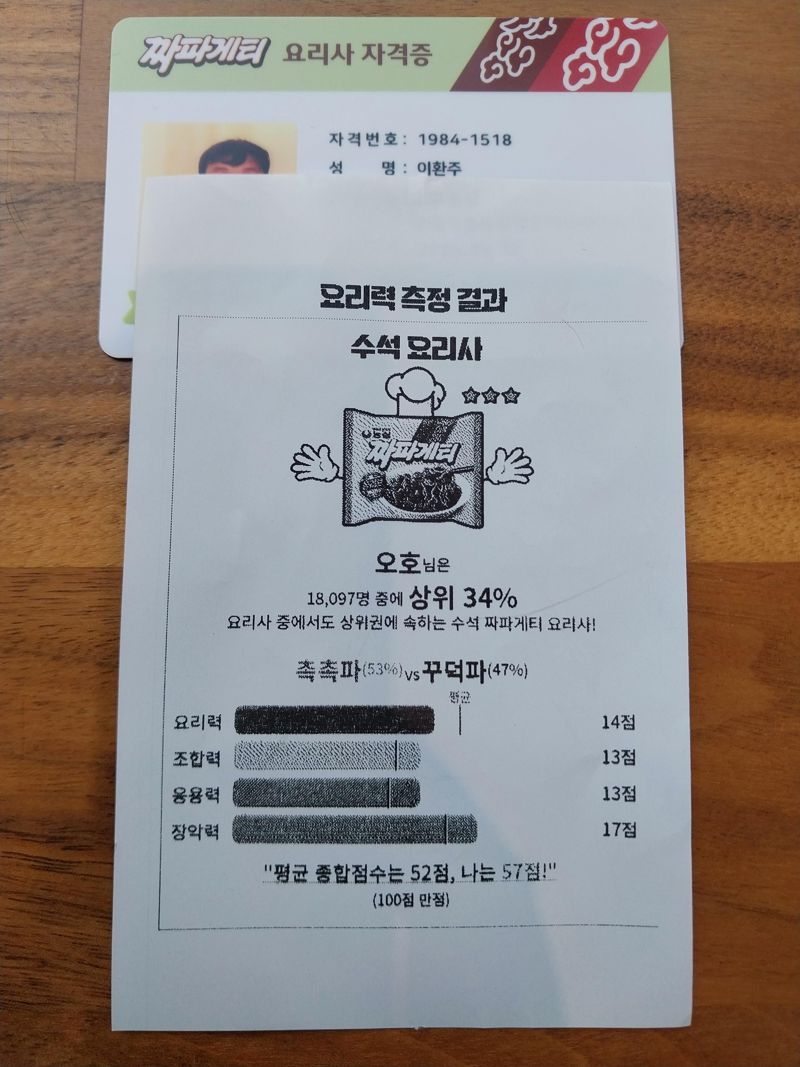
Last month I stopped by the Chapagetti pop-up store in Seongsu-dong, Seoul. In the play zone, I entered my personal Chapagetti preferences into a kiosk — firm noodles or soft, how much broth I like, how I cook it. Out came a result card telling me I fell into the top 34 percent of 18,097 people and ranked as a "head chef." A moment later, out slid a "Chapagetti Chef License" card that looked exactly like a national ID.
The delivery app Baedal Minjok held its first "Chimmelier" chicken-tasting exam back in 2017. "Chimmelier" — a portmanteau of chicken and sommelier — was run with a straight face, with a written test and a practical test. Blind-taste questions asked which brand a piece of fried chicken came from by look or flavor; other questions asked test-takers to identify a brand's jingle from its ad music. The Chimmelier certification was even registered as a private-sector qualification.
The liquor company HiteJinro has handed out "So-maek Licenses" too. It ran a contest for the best personal recipe of somaek — the soju-and-beer cocktail — and awarded the winner a "somaek-mixing expert" certificate for finding the golden ratio between the two.
Chapagetti chef, Chimmelier, so-maek license — all of that I could file under the wit of a nation that loves satire and playfulness.
But last week I sat in on a global hansik symposium and found myself genuinely startled. The top gastronomy figures from Korea and around the world, along with pros from a range of industries, had gathered to lay out an ambitious plan: train professional "Korean-style BBQ" specialists, put a standardized certification behind them, and export those pro grill-masters to the world. I started listening in a light mood; it didn't take long to realize the room meant it. As I sat through a very serious "solemn-font lecture" on grilling meat, the opening line of Yoon Jong-shin's song "Uphill" came to mind: "From here on, the smiles are going to disappear."
Meat-grilling — like the mattress ad said, "it's science"
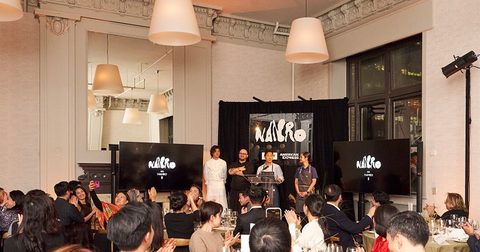
April 29, Leeum Museum of Art, Seoul. "The hansik boom has produced a new global genre called Korean BBQ," Chef Bae Jae-hwan of NANRO LAB said on stage. "But the fatal weakness of our grilling culture is the absence of any standard or benchmark — that makes its role hard to explain."
To break through this, he laid out his blueprint: NANRO LAB will strengthen a chain of empirical research → training the next generation → international solidarity for Korean BBQ, building a triangular success across science, technique and business.
NANRO INSIGHT, held April 29–30, was the first public event organized by the Nanro Foundation, chaired by Chef Choi Jung-yoon, head chef at Sempio's Woorimat Research Center. The community that carries the same name started in 2022, taking its cue from nanro-hoe — the meat-grilling tradition that Silhak scholars such as Park Ji-won and Jeong Yak-yong are said to have enjoyed. This was its first symposium open to the general public.
Sharing the stage with Chef Bae, senior researcher Lee Yoo-jin of NANRO LAB presented the lab's findings under the theme "Scientific research on Korean meat-grilling."
According to Lee, achieving the best possible grill requires controlling variables that include the grill plate, the heat source, the tools (tongs, shears and the like), ventilation, and the grilling technique itself. The most fundamental thing, of course, is a good cut of meat.
"In Korea, we divide beef into 120 cuts. We're building a dictionary of hanwoo cuts, because the names differ from region to region, and then classifying each cut anatomically by moisture, protein and fat distribution," she said. "For this research, we focused on tenderloin, striploin and boneless short rib."
She continued: "There is geometry hidden in the grill plate itself — its material, its thickness, the height of the heat source, its tilt all shape the result. Ventilation splits into upward and downward exhaust systems by placement, and depending on conduction, radiation and other modes of heat transfer, the effect on flavor changes."
Take short ribs. Anatomically, they carry a lot of fascia and connective tissue that protects the cow's organs — which gives them a chewy texture. Being close to the viscera, they also carry a strong meaty and offal-like scent, and are high in fat. Read those traits, run them through a formula, and you can build the optimal grilling method scientifically, Lee argued. Starting with beef, the plan is to develop grilling formulas for pork, duck and other meats in turn. The "formula" for the best grill, she said, will be available at the Nanro Master Class.
The Nanro Foundation says it will train pro grill-masters as a route to globalizing hansik.
"If we can grow a 'Grill Master' credential into a recognized private-sector qualification, we can extend that into education, entrepreneurship, tourism, distribution, entertainment and manufacturing," Chef Bae said. "Through a Grill Master, you get better hospitality, higher customer satisfaction, better brand margins and expansion of related industries."
Is cooking art, or is it technique?
Is cooking an art or a technique? Today the two words point in very different directions, but they used to mean the same thing.
"Life is short, art is long." That line comes from the ancient physician Hippocrates. It is often used to say that art outlasts a finite human life — but that reading is a misunderstanding. Hippocrates was in fact watching countless people die in war, and used the phrase to mean that so many are dying, while a lifetime is too short to master the technique — the art — of medicine.
In one of the sessions on the first day, author and "mind-miner" Song Kil-young put a question to Chef Oriol Castro of Disfrutar, the Spanish three-Michelin-starred restaurant known for its inventive cooking.
"You cook creatively — how are chefs different from film directors, who are called artists?" Castro answered: "I think of myself as a cook, not an artist."
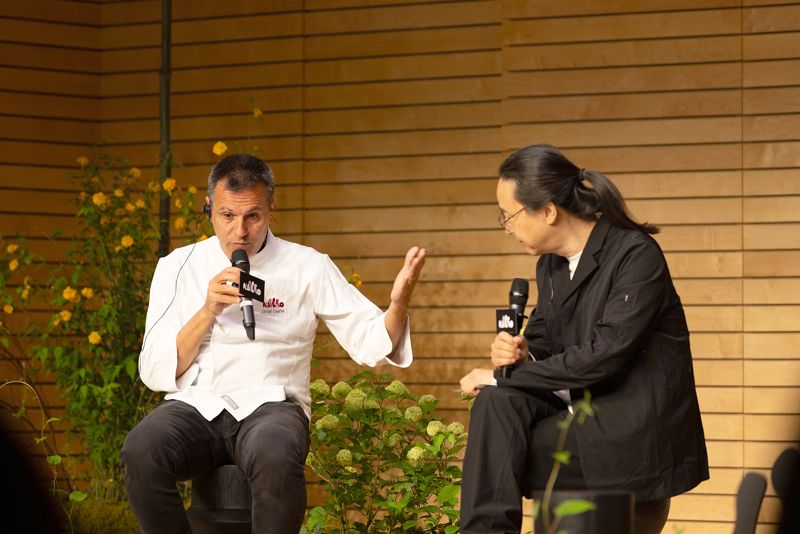
Castro's answer carries real weight for the day's discussion. If cooking belongs to the realm of art rather than technique, then "Grill Master" as a profession becomes either impossible or extremely hard to realize. To be a trade, a thing has to be reproducible from a recipe or a manual — the same conditions have to yield the same result, as they would in a lab experiment.
Even if a student learns to make the world's best sushi from a master, none of it helps unless the apprentice's hands can pick up exactly 280 grains of rice at a time. Master craft edges close to art. It has to be acquired through long training and experience, and refined over time.
Knowledge that can only be acquired by moving your body, running into the work in person, is called tacit knowledge or embodied knowledge. Tacit knowledge is expertise or capability that lives inside a person's skill and experience but resists being put into words. The Nanro Foundation's goal is to raise and spread the know-how of hidden grill-masters across the country — that is, to standardize and manualize the technique and know-how of Korea's grilling artisans, and lead with that into the globalization of hansik.
· Original (Korean): fnnews.com